Devouring Culture

The myriad ads shown during the Super Bowl surprised, entertained, inspired, and even offended over 100 million people on Sunday night–myself included.  I confess despite growing up near Gillette Stadium (still Sullivan Stadium to locals), I really only watch one or two games a year.  The game this year was a fun diversion from the Anderson Silva head kick replay I’ve been glued to since Saturday night.

Aside from the creepy finger-licking Doritos promo and the self-deprecating Ozzy/Justin Bieber combo, one advertisement is really stuck in my mind.  It’s the second one by Groupon.  If you haven’t seen it yet, here it is.

A simple piece of satire, really.  It opens with shots of Tibet and ends with an American doing what we do best–spending money and eating.  The controversy lies in the interpretation.  Groupon reps claim to be making fun of themselves.  I read in the Chicago Tribune:

“Groupon Chief Executive Andrew Mason responded to the criticism in a Monday blog post, explaining that the ads were meant to draw attention to philanthropic causes by humorously highlighting “the often trivial nature of stuff on Groupon when juxtaposed against bigger world issues.”

I guess I’m not seeing it.  They ended up offending those involved in the Tibetan cause, the Chinese, and, of course, the real butt of the joke, the American consumer. Tsk, tsk on Mr. Mason for pointing out our ignorance, insensitivity, and addiction to tasty fish curry.  You didn’t rake in any donations, either.

There is a point at which this discussion become pertinent to this website, I believe.  If you read my last post, you probably noticed I occasionally indulge in a little crass humor myself.  That may disqualify me from rallying against the Groupon commercial, yes, even though I didn’t think it was funny either.  I would, however, like to make an observation.

America is meant to be a culturally tolerant place.  I know that’s an ideal, and we preach about our enlightenment much more than we practice it.  If this poorly placed ad shows anything it’s this fact.  It did get me thinking though about how we consume culture in this country and what we do with the leftovers.

Like the actor in the commercial, it’s all too easy to ignore where the diverse cultural advantages we enjoy come from and how lucky we are to live in a place that, at least ostensibly, appreciates pluralism in ideas and lifestyles.  The food, technology, entertainment, religions, and the even martial arts of other countries take root and thrive in America, and we are fortunate to have the opportunity to take part in their traditions if we choose.

But to devour the richness of the world around us without paying homage to the people and places that surround us is a travesty.   As martial artists, we should be even more attuned to the cultures and traditions that add so much balance, peace, and joy to our lives.  We should always be mindful of the origins of our arts; otherwise, we’re simply robbing from those we should truly respect.  Let’s not fall into that trap that is simultaneously un-American and completely commonplace.

So . . . I guess I’ll hop off my tiny soapbox and pass the mic.  What did you make of the Groupon ad?  Maybe I’m reading too into it?  What about the other ads last Sunday night?  And how about that Anderson Silva headkick?  Did he really learn that from Steven Seagal?

Posted in News, Philosophy | Tagged , , , | 1 Comment

My First Time

Most of us remember this event pretty vividly. It’s hard to forget the sweat, the groans, the pain, and the embarrassment. For some it was no big deal, for others it was life changing. Some swore off it immediately, while others still can’t get enough. No matter how you feel about it now, it’s safe to say nobody forgets their first time

You know, the first time you tried jiu-jitsu. What were you thinking of?

I remember my first class like it was yesterday. The instructor introduced me to everyone on the mats, which was thoughtful and made me feel welcome. Then we worked from standing, trying to arm drag (whatever that meant) to take our opponent’s back. I was worried about my performance, but the blue belt I was working with was quite gentle. He went out of his way to explain a few techniques to me and to ease my nerves. I felt myself start to relax and enjoy the new experience.

Later in the class we switched partners, and we drilled the standard classic “Gracie” guard pass. I was now with a brown belt. He obviously had a lot of grappling experience. He was assertive and clearly told me what would work best in this new situation. I became more comfortable and confident and began moving faster and faster.

After a quick break, our coach set up a new drill. The partner on the bottom was to provide resistance while the partner on top tried to pass his guard. So I knelt between my partner’s legs and got ready for action.

Things went downhill fast. I grabbed and scrambled and clawed and grunted. I even tried standing up. Soon I was breathing heavy–gasping for air–while my partner barely moved. I was obviously getting it all wrong; I could tell because he looked somewhat bored and let me do all the work.

Then he left me to spar with someone else.

I learned that I had a lot to learn. I found that if I wanted people to roll with me, I would have to make sure both our needs were met. I would need to master some new moves to ensure a mutually gratifying experience.

Needless to say, I fell right to sleep after class that night and dreamed of things to come.

____

Thanks for reading. I hope that you enjoyed this article as much as I did. If you want to share your story, remember to leave a little to the imagination. This isn’t one of those websites, after all.

Posted in Humor, Jiu-jitsu | Tagged , , , | Leave a comment

Random Poll

Posted in Polls | Tagged | Leave a comment

The Slow-Carb Diet: Week One

I promised a series, and here it is–a few posts looking back on my month-long experiment with the Slow-Carb Diet as detailed in Timothy Ferriss’s The 4-hour Body. To recap, the diet has a few different rules, specifically to avoid sugar, grains, dairy, and fruit in favor of more animal protein, nuts, beans, and legumes.  Once per week, you can splurge on the banned foods.  This binge is meant to boost fat loss and to stave off ketosis.

In the spirit of the season, I began the Slow-Carb diet right after New Year’s.  It wasn’t really a resolution, and I tried the diet less for weight reduction and more for energy regulation.  My initial observations we positive in this regard.  Ferriss sugggests eating at least 20 grams of protein per meal to provide consistent energy and to reduce hunger pangs between meals.  My new meals were combinations of eggs, lean meats, almonds and almond milk, broccoli, spinach, eggplant, celery, avocados, hummus, peanuts, and lentils.  I also ate LOTS of canned beans and salsa.  I used Trader Joe’s Green Drink and fish oil capsules for supplements.

Here are my initial findings:

PROS

My days at school are often a battle against a constant urge to eat–partially due to stress, I’m sure.  However, during the first few days, I noticed a change.  I didn’t feel overly hungry or faint at all, and I could go longer without eating.

If you routinely eat a lot of carbohydrates you won’t realize how much of a “rush” they can produce.  Even if you avoid refined carbs, whole grains have a similar, if muted effect.  I especially noticed this at breakfast.  Replacing my Kashi or oatmeal with eggs, black beans, and veggies totally changed my mornings.  Cravings for sugar and caffeine, essential ingredients used to maintain the “high” experienced from carbs, were more or less eliminated.  I’m known for my sweet tooth, but I really didn’t feel the need to indulge this week.

I didn’t even really binge that much on my first cheat day.  I started on Saturday night with sushi, noodles, and a glass of beer.  I had a big bowl of whole-grain cereal on Sunday morning and some surplus holiday candy.  I was back to the diet by Sunday afternoon.

CONS

I did immediately notice one ill effect of the diet.  If you couldn’t tell from the foods listed above, gas and bloating can be a major issue!  It’s been pretty cold lately and sleeping on couch is no fun . . .

I also felt like the diet had an adverse effect on my training this week.  I had taken some time off during the holidays and due to some family health issues.  Admittedly, I wasn’t in peak condition.  Barring these variables, I noticed less energy available to my body while training–especially during anaerobic portions of my workouts.  I just didn’t feel like I had any “kick” and missed that feeling.  I later tried eating some fruit one hour prior to training with some good results.

Factoring in my lack of conditioning and the drastic changes to my diet, my jiu-jitsu test that week was especially trying!  I started my first cheat day right after the workout.

WEEK ONE CONCLUSIONS

Weighing the pros and cons, I think I got off to a good start.  Any changes in your way of eating will produce significant results and require time to adjust.

I did drop about eight post-holiday pounds this first week.  Much of this could be from the elimination of huge meals and constant snacking rather than from the slow-carb changeover.  I will include more on weight loss to follow.

Lastly, please keep in mind that this experiment was completely unscientific.  I didn’t keep any data aside from checking my weight a few times each week.  This first week was my strictest in terms of adhering to the diet; I followed it to the letter.  Later I adapted a little bit to provide myself with quick energy before workouts and to promote recovery.


There’s more to come.  Please let us know if you have questions and if you’ve tried any diet experiments lately!

Posted in Nutrition | Tagged , , , | 4 Comments

The Missing Links: Training the Hands, Neck, and Core

This is a mini-review of Ross Enamait’s new DVD, The Missing Links.  For those who are unfamiliar with his methods, Ross is a master at “low tech, high effect” training.  His other materials completely changed my exercise philosophy.  A few years ago, I went from long, ineffective sessions characterized by weight-room chatter and plodding jogs, to short, intense workouts that often leave me panting on the floor.

His workouts are tough, but I’ve really come to appreciate the results!

This time, Ross focuses on the oft-neglected hands, neck, and core.  He stresses that strengthening these areas are not only crucial for fighters and martial artists but for overall fitness as well.  Anyone living in New England can appreciate the need for a stable core, strong grips, and a flexible neck after all the shoveling this winter!

If you get a chance, check out his website and this new title.  Even though some of the exercises won’t be new to experienced martial artists, there’s a lot to be learned in this two DVD set.

Posted in Fitness, Reviews | Tagged , , , , , | 5 Comments

Random Poll

It’s another snowy day in CT.  How do you keep up with martial arts when you can’t get to the gym/dojo?

Posted in Polls | Tagged , , , , | Leave a comment

The Slow-Carb Diet: An Introduction

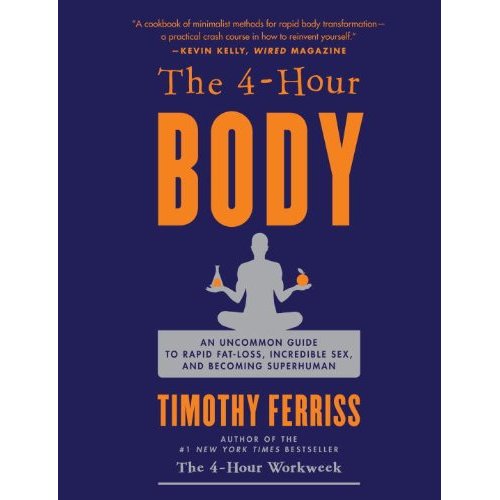
I got Timothy Ferriss’s newest book, The 4-hour Body for Christmas and couldn’t wait to get into it.  I am a big fan of his first book, The 4-hour Workweek, and I use a lot of his advice to streamline my work in and out of the classroom.  There’s a common misconception among many these days that teachers just coast from vacation to vacation, biding their time until retirement.  Thankfully someone like Ferriss came along to help make our jobs even easier!  Jeez.  What a bunch of slackers we are!

I could go on, but I’ll spare the oncoming, sarcastic rant for another post.  (Deep breaths.)

Anyhow, I’m a Ferriss fan, and I was excited to receive this book.  This time, instead of writing about personal productivity, he explains how to hack the human body for maxim health and performance.

There’s a lot of neat information in this book on how to run faster, lift more weight, improve your baseball swing, and how to please the ladies.  Given my expertise in all these things, I decided to skip those chapters to focus on his “Slow-Carb” diet.

Ferriss advertises this diet, which is similar to Atkins or South Beach, as a way to “Lose more fat than a marathoner by bingeing!”  This didn’t really interest me either.  I love to eat, don’t get me wrong, but I’ve successfully maintained my weight and body fat percentage for a while now and felt pretty comfortable with my ways of eating.

What I sought was a way to regulate my energy levels.  I’ve had trouble with this since I started teaching.  At first, I was coming off of a two-pot-per-day coffee addiction (born from the office drudgery I faced at my old job).  My first year as a teacher I nearly passed once in front of a room full of kids because of low blood sugar: that was the inspiration for my initial changes in nutrition.

I learned to moderate my portions and to minimize my caffeine intake.  I changed my conditioning regimen from lifting some weights and jogging around the neighborhood once in awhile to consistent, intense workouts to complement my martial arts training.

Most recently, after reading books like In Defense of Food and watching movies like Food, Inc. I flirted with a near complete plant-based diet.  I’d been limiting meat servings to a few times per week and have focused on sustainable whole foods–especially whole grains, fruits, and vegetables.

My food confession has a point: I wanted to try a more common-sense approach to keeping my insulin levels low from meal to meal.  I still didn’t feel like I had it quite right.  If I went too long between meals, I felt faint.  I craved a lot of sugar and was almost always thirsty.  I started to think that maybe, just maybe, I was eating too many carbs . . .

I researched the Paleo diet, and considered trying it before Ferriss’s new book caught my attention.  It holds many of the same tenets, except one important item–the cheat day.

Here are Ferriss’s rules:

1. Avoid “white” foods. – This includes ALL processed carbohydrates, whole grain or not.  Dairy is also to be avoided as it can spike insulin and thus increase body fat.

2. Eat the same meals over and over again. – Not a problem for anyone strapped for time.  My experience is that it helps your body know when to expect calories and nutrients every day, and it helps to regulate energy levels.

3. Don’t drink calories. – This is a no-brainer for most of us, but do you count your sports drinks or the milk in your coffee?

4. Don’t eat fruit. – I can’t really adhere to this one.  I prefer to have a serving of fruit as a snack without combining it with any other food so as not to trigger an insulin response.  I still need the quick energy from time to time.  I am limiting my portions, though.

5. Take one day off per week and go nuts. – This could easily be the main appeal to this diet.  Ferriss advocates breaking all the rules once a week.  According to his research, this actually regulates hormone levels, boosts metabolism, and increases fat loss.  Plus you get to pig out!

Can you sense a series coming on?  I’ve had some good luck with this diet so far, though there have been some ups and downs.  Over the next few weeks I’ll detail my experience with “slow-carbs” and how they jibe with the demands of martial arts training.  Ferriss, an efficiency pioneer, suggests limiting exercise for maximum results.  For many of us that isn’t an option, so some tailoring will be necessary.

Has anyone else experimented with this diet or one similar?  Please share your experiences now and as we move along in the series.


Posted in Fitness, Nutrition, Reviews | Tagged , , , , | 1 Comment

New Website, First Draft

Hi, Everyone:  After discussing names and other options with readers, I present to you the first draft of our new website.  I hope you like it!  You should see a new, broader focus on collaboration on this blog and a wider emphasis on different styles, health, training, and nutrition.   Please leave a comment providing further suggestions on what you’d like to see!

Also, here is our new mission statement.  It should sum up the direction this site will take in the next few months.

“Moai Martial Arts is devoted to the development of mental, physical, and spiritual vitality, enabled through martial arts training and knowledge, that is shared by a community of open-minded individuals.  We can use this site to work together for our common good.  Please join us in our pursuit by contributing comments and content!”

Here’s a quick vocabulary lesson comprised of a few neat words I’ve learned lately.

1. Moai (moe-eye) – In Okinawa, these small groups are the original “social networks” in which people meet to share interests, experience, and to support one another emotionally (and financially) through good times and bad.  I hope this website can function like a moai in spirit, if not in a monetary sense.

2. Yuimaru (you-ee-mah-roo) – is the concept of reciprocity and working for the common good as expressed in Japan.  It’s something that seems to be missing in a lot of what we can consider “martial arts culture” right now, and we need to make it a priority.

To these ends, Moai Martial Arts is now seeking content.  If you’d like to write an article, post a review, or promote a website, please send me an e-mail (moaimartialarts@gmail.com) to get started.

Also, notice the RSS feeds on the right.  Take a look at all the great martial arts news and information that’s out there!

There is are many more changes and and new features to come.  Again, thank you so much for a wonderful first year of blogging.  I hope year two grants us new learning and an even closer friendship!

Posted in News | Tagged , , , | 1 Comment

Help!

Thanks for your input so far.  Based on what readers have shared with me, here are a few possible names for the new website.  They’re mixed and matched from some of the ideas I’ve gathered.  Please vote and weigh in on what name you like best.  If you chose “other”, don’t forget to offer a suggestion in the comments!

Posted in News | Tagged , , , | Leave a comment

Website Redesign Coming Soon

I’ve been thinking of revamping the site for awhile now, and I am looking for a little input.  What are some design elements or features you would like to add or subtract from this blog?  How can I make it more useful to you, and how can I increase the accessibility of the site; that is, what can I change that would make you more interested in participating?  I’d like to move the focus of the site away from mainly my writing to make this blog more of a place enjoyed by the martial arts community at large.  Thoughts?

In that spirit, I’ve also been toying with new names for the site and URL.  I spent the last few days looking up words that embody a different, more communal and informal vision.  Over the last year or so, my articles have shifted from just Shohei-ryu and jiu-jitsu; I’d like to host a broader discussion about martial arts, personal improvement, and wellness in general. 

Would you be interested in contributing content?

Here are some concepts I’m thinking of regarding the new name.  I’m not sure how they should (or shouldn’t) fit together.  What do you think?

Blue Zones are areas of the world where people live the longest and are considered the happiest.  Health and happiness are why many of us started training in martial arts in the first place!  You can see author Dan Buettner’s explanation in TED lecture or on his website.

Moai (pronounced moe-eye) are the original “social networks” in which people meet to share interests, experience, and to support one another emotionally (and financially) through good times and bad.  The best martial arts schools function much the same way, minus the banking connotation.  A good website should offer the same support.  Moai was developed in Okinawa, and Buettner suggests is one of the reasons why denizens live healthy, fulfilled lives.  Skip to 7:20 for his explanation.

Yuimaru is the concept of reciprocity and working for the common good as expressed in Okinawa.  In The Okinawa Program, Bradley and Craig Wilcox, and their co-author Makoto Suzuki say, “In a sense, it is similar to the ‘help thy neighbor ethic of the farmers of the American Midwest and Canadian prairies” (8).  This embodies the spirit of traditional martial arts, I think: through teaching and learning we all help each other to improve.  Therefore, yuimaru should also be considered during the naming process.

In essence, I’m trying to develop a sense of mental, physical, and spiritual vitality, enabled through martial arts training and knowledge, that is shared by a community of open-minded individuals.  We can use this site to work together for our common good.

Are you in?

Posted in News | Tagged , , , | 3 Comments